CuePD Extend logo
View on ClinicalTrials.govClinicalTrials.gov
A Northumbria University research study

CuePD-Extend

Retraining gait at home, one song at a time.

CuePD-Extend tests a smartphone app that senses how you walk and plays personalised music cues to help retrain your steps, in your own home.

Northumbria University Parkinson's disease Home-based

About the study

CuePD in the Home: Retraining Gait in Parkinson's Disease Via a Personalised App, known as CuePD-Extend, is a research study run by Northumbria University. It builds on the completed CuePD study by moving gait retraining out of the clinic and into everyday life.

Parkinson's disease often changes the way people walk, which can raise the risk of falls and affect quality of life. Rhythmic auditory cues, and music in particular, have been shown to help regulate walking, but cueing works best when it is tailored to the individual.

CuePD uses the motion sensors already inside a smartphone to assess walking in near real time, then delivers personalised auditory cues, including music matched to a target step rhythm, to help retrain gait. CuePD-Extend evaluates how this approach works when people use it themselves, at home, over time. The findings will show for whom, and under what conditions, personalised music cueing is most helpful.

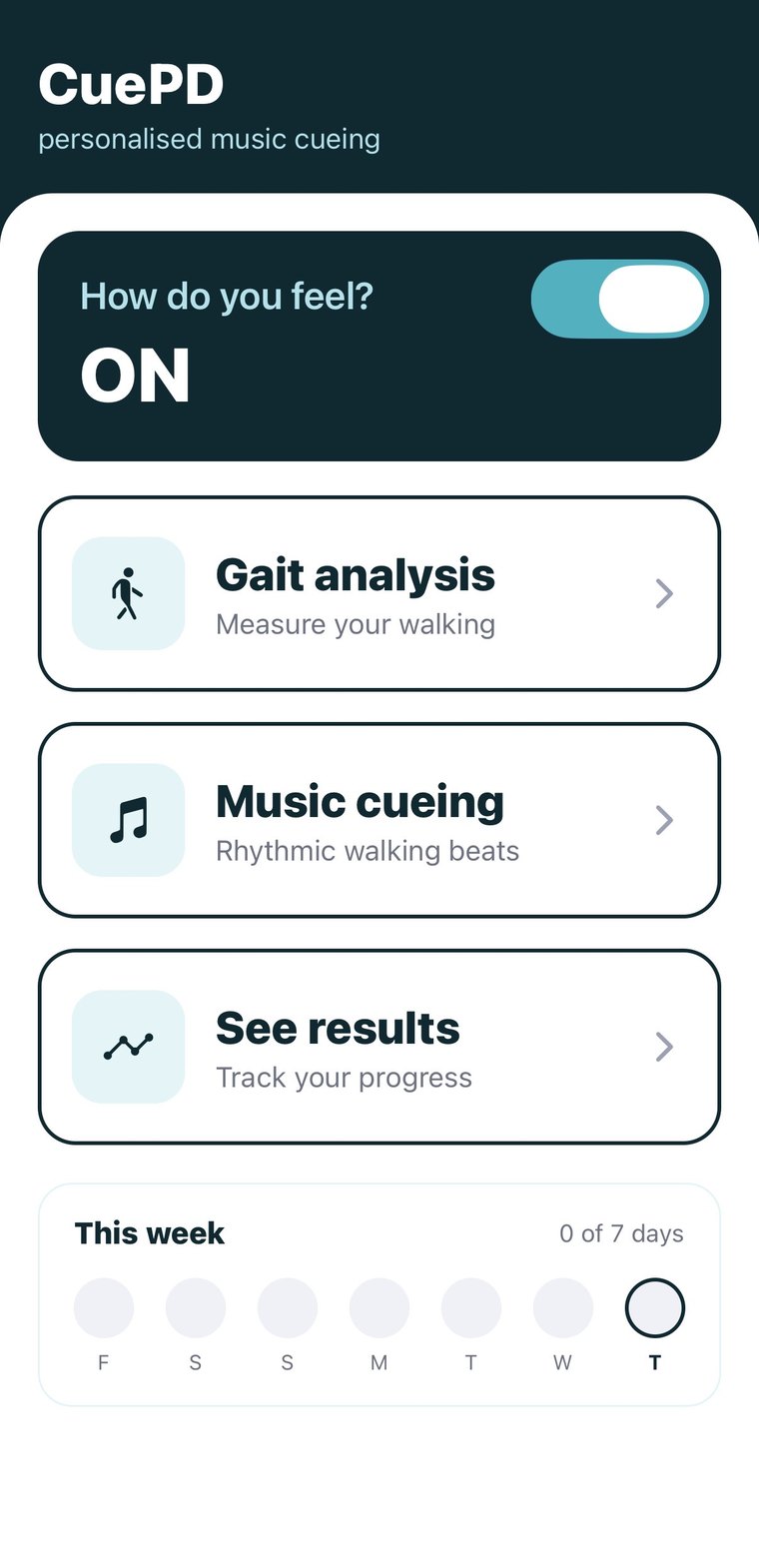
The CuePD app home screen, showing a cueing on/off switch and options for gait analysis, music cueing and results.

How CuePD works

Three steps, all on a phone the person already owns, with no extra wearables to set up.

01

Sense

The phone's built-in motion sensors capture and analyse walking, including step timing, cadence and rhythm, in near real time.

02

Personalise

Music is matched to each person's target step rhythm, so the cue fits their walking rather than a generic metronome beat.

03

Retrain

People use CuePD during everyday walking at home, building a repeatable routine that aims to support steadier gait over time.

Research team

CuePD-Extend is delivered by a multidisciplinary team at Northumbria University, spanning engineering, health economics and clinical care.

CW

Conor Wall

Lead researcher & app developer
Google Scholar
AG

Alan Godfrey

Senior lead / principal investigator
Google Scholar
RW

Richard Walker

Clinical investigator & supervisor
Google Scholar
PM

Peter McMeekin

Supervisor & co-investigator
Google Scholar
RV

Rodrigo Vitorio

Co-investigator & methodology
Google Scholar
VH

Victoria Hetherington

Co-investigator
Google Scholar

Project administration by Alan Godfrey.

Previous publications

Peer-reviewed and conference work behind the CuePD programme.

2026PAPER

Retraining gait in Parkinson's Disease via a personalised app: A study protocol

Wall C, McMeekin P, Hetherington V, Morris R, Vitorio R, Walker R, Godfrey A
PLOS One · 21(4) · e0346508
2026PAPER

Parkinson's disease gait rehabilitation at scale: Insights on personalised smartphone-based music cueing

Wall C, Sacre A, McMeekin P, Walker R, Hetherington V, Celik Y, Vitorio R, Morris R, Godfrey A
PLOS One · 21(1) · e0340106
2025PAPER

A scalable and personal approach to gait rehabilitation beyond the clinic

Wall C, McMeekin P, Hetherington V, Morris R, Vitorio R, Walker R, Godfrey A
Expert Systems with Applications · 285 · 128090
2024LETTER

CuePD: An IoT approach for enhancing gait rehabilitation in older adults through personalised music cueing

Wall C, Young F, McMeekin P, Hetherington V, Walker R, Morris R, Barry G, Celik Y, Godfrey A
IEEE Sensors Letters · 8(10)
2023CONF.

A proposed pervasive smartphone application for personalised gait rehabilitation

Wall C, Young F, Moore J, McMeekin P, Walker R, Godfrey A
IEEE 19th Int. Conf. on Body Sensor Networks (BSN) · pp. 1-4
2023ABSTRACT

Gait retraining to reduce falls: an experimental study toward scalable and personalised use in the home

Wall C, McMeekin P, Walker R, Godfrey A
The Lancet · 402 · S92

Part of the CuePD research programme

CuePD-Extend continues work at Northumbria University on scalable, personalised gait rehabilitation that uses everyday smartphones and music-based cueing. The study protocol and earlier publications set out the approach and the evidence behind it.

Funded By

Parkinson's UK